Business Guide to Energy Procurement
What does energy procurement mean for large organisations?
For the modern enterprise, energy has shifted from a passive operational cost into a primary strategic risk. In the current market, Business Energy Procurement is defined by a fragile market equilibrium. While wholesale gas prices have stabilised following the historic shocks of 2022, the “delivered” cost of electricity remains approximately 35% higher than pre-crisis levels. This is largely due to the escalating cost of grid infrastructure modernisation, the recovery of “Supplier of Last Resort” (SoLR) levy costs, and carbon-related balancing charges.
Strategic energy procurement services now function as a “Unified Acquisition Engine.” This means shifting from siloed, reactive buying to a centralised strategy that secures budget predictability and supports Business Energy Efficiency goals. To fully understand how these forces interact at scale, organisations can refer to our guide What Is Business Energy Procurement? A Practical Guide for Large Organisations. Industry market data indicates that non-commodity charges (the network fees and government levies added to every bill) now account for approximately 60% to 64% of a typical business electricity invoice. Energy is no longer an overhead to be paid; it is a strategic risk to be hedged.
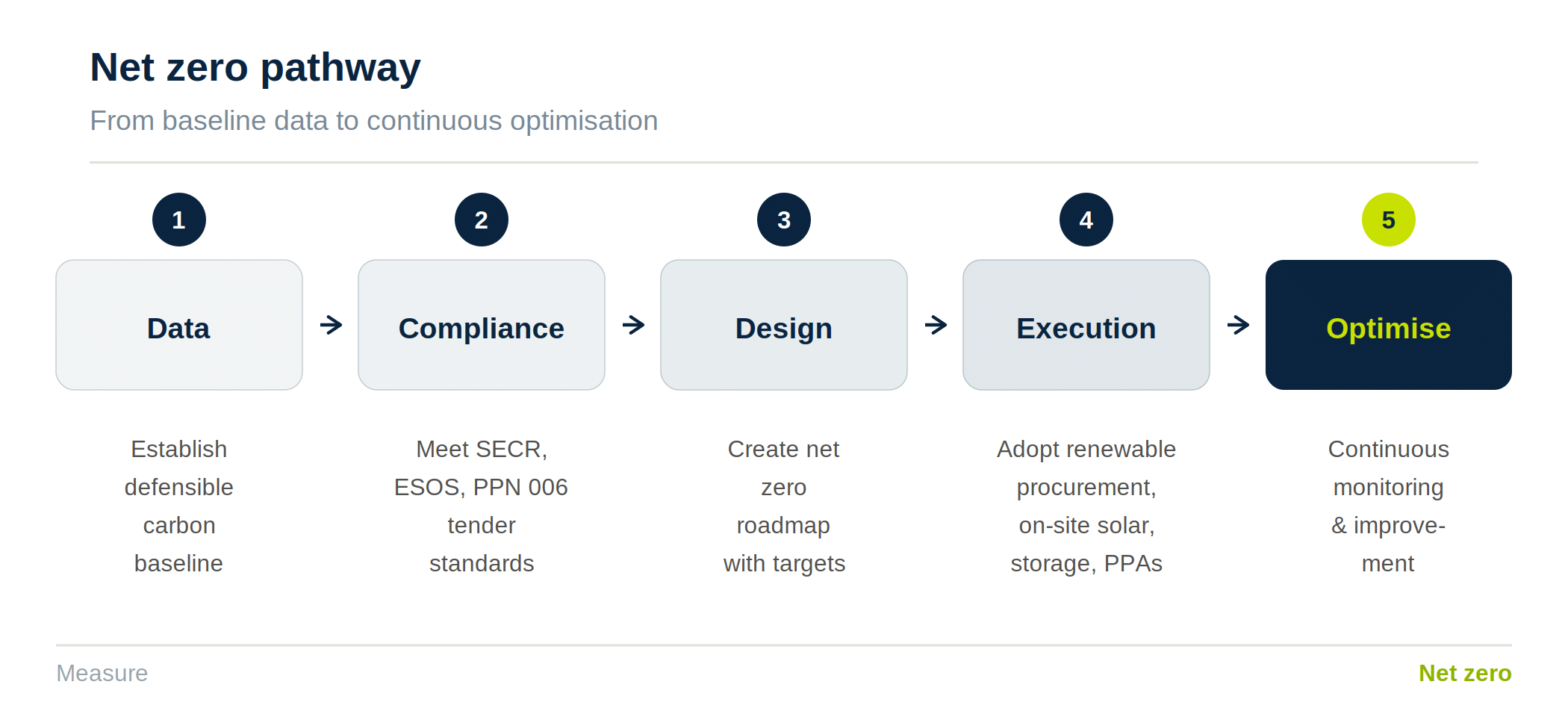
Crucially, procurement is no longer just about the unit price; it is about the Equity Energies Net Zero vision. In the current regulatory environment, an organisation’s energy strategy is its primary vehicle for decarbonisation, and Net Zero targets increasingly shape access to finance, customer relationships and competitive advantage in tender processes. Failing to align procurement with a formal Net Zero roadmap also carries a ‘greenstalling‘ risk, where fear of scrutiny or of taking the wrong first step stalls progress, leading to commercial stagnation and the loss of high-value contracts.
“Failing to align procurement with a Net Zero strategy can reduce competitiveness in tenders where environmental performance and credible decarbonisation plans are evaluated.”
– Equity Energies
For a Director of Finance, Corporate Energy Procurement must be a defensive strategy against a market where the raw commodity is only one part of the financial equation. Navigating this environment requires staying ahead of seasonal pricing trends and grid shifts, which presents its own challenges and often business will seek external support and guidance.
The focus has moved beyond the unit rate to include the management of “Time of Use” (ToU) tariffs and the mitigation of peak-time distribution costs. Large organisations must now account for the impact of the Targeted Charging Review (TCR), which has fundamentally altered how residual network charges are recovered from businesses through fixed-tier charging blocks.
How TCR Banding Works
The table below shows how business electricity connections are grouped into fixed charging bands under the Targeted Charging Review (TCR).
| Supply Voltage | Band 1 | Band 2 | Band 3 | Band 4 |
| LV | ≤80 kVA | 81–150 kVA | 151–231 kVA | >231 kVA |
| HV | ≤422 kVA | 423–1,000 kVA | 1,001–1,800 kVA | >1,800 kVA |
| EHV | ≤5,000 kVA | 5,001–12,000 kVA | 12,001–21,500 kVA | >21,500 kVA |
Source: Ofgem TCR framework and DCUSA residual charging guidance.
This necessitates a forensic approach to meter classification to ensure sites are not incorrectly banded, which can lead to significant annual overcharges.
“Energy is no longer an overhead to be paid; it is a strategic risk to be hedged.”
How the energy procurement process works in practice
A professional Energy Procurement Process must be rigorous and evidence-based. To build operational credibility, the lifecycle follows six distinct stages to ensure data integrity precedes any market engagement.
1. Data Aggregation and Forensic Auditing
The foundation of a robust energy buying strategy is the collection of 24 months of Half-Hourly (HH) data. This allows for a granular analysis of Business Energy Consumption patterns. Up to 20% of industrial utility bills contain errors in non-commodity calculations. A forensic audit at this stage identifies historical overpayments in DUoS (Distribution Use of System) or misapplied VAT on CCL (Climate Change Levy) exemptions. Forensic analysis also involves checking the “Agreed Capacity” (kVA) against actual peak demand; many businesses pay for capacity they never use, resulting in thousands of pounds of “dead” costs annually.
2. Risk Appetite Profiling
Energy buying is a form of financial hedging. Stakeholders must determine the organisation’s tolerance for market movement. An organisation with tight margins prioritises the absolute certainty of a fixed rate, while a commercial estate with higher liquidity might choose a flexible approach to capitalise on market dips. This stage requires a documented “Risk Management Policy” (RMP) that defines when and how much energy to hedge to prevent emotional decision-making during market spikes.
3. Defining the Procurement Framework
The chosen model must align with the corporate fiscal calendar. This includes deciding on contract length, volume tolerances, and the organisation’s energy and emissions reporting requirements, including SECR where applicable, and its renewable electricity strategy. For multi-national organisations, this phase must also consider the “Location Marginal Pricing” (LMP) trends that are beginning to influence how grid costs are allocated across different geographic zones.
4. Competitive Business Energy Tendering
To create genuine competitive tension, the Business Energy Tendering process must engage a panel of at least 15 to 20 suppliers. This goes beyond the “Big Six” to include specialist generators and Corporate Power Purchase Agreement (PPA) providers. In 2026, the tender must also scrutinise the supplier’s financial stability (Credit Risk) to ensure they can survive potential market volatility during the contract term.
5. Technical Evaluation of “Delivered” Costs
A side-by-side comparison must account for non-commodity “pass-through” charges. Different suppliers apply risk premiums to network costs in varying ways, making it essential to look past the headline unit rate. This evaluation includes a detailed check of “Force Majeure” and “Change in Law” clauses, which have become more aggressive in supplier contracts following the 2022 energy crisis.
6. Registration and Transition Management
Managed registration ensures no site falls onto expensive “out-of-contract” rates, which in 2026 can be 100% higher than negotiated market rates. This phase involves managing “Objections” from incumbent suppliers and ensuring that Meter Operator (MOP) and Data Collector (DC) agreements are correctly assigned to the new contract.
Fixed vs. Flexible: Choosing the right procurement model for your risk appetite
The decision between Fixed vs Flexible Energy Procurement is the single most influential factor in long-term cost outcomes. For a detailed analysis of these models, see our guide on Understanding Flexible and Basket Energy Procurement.
1. Fixed Energy Procurement
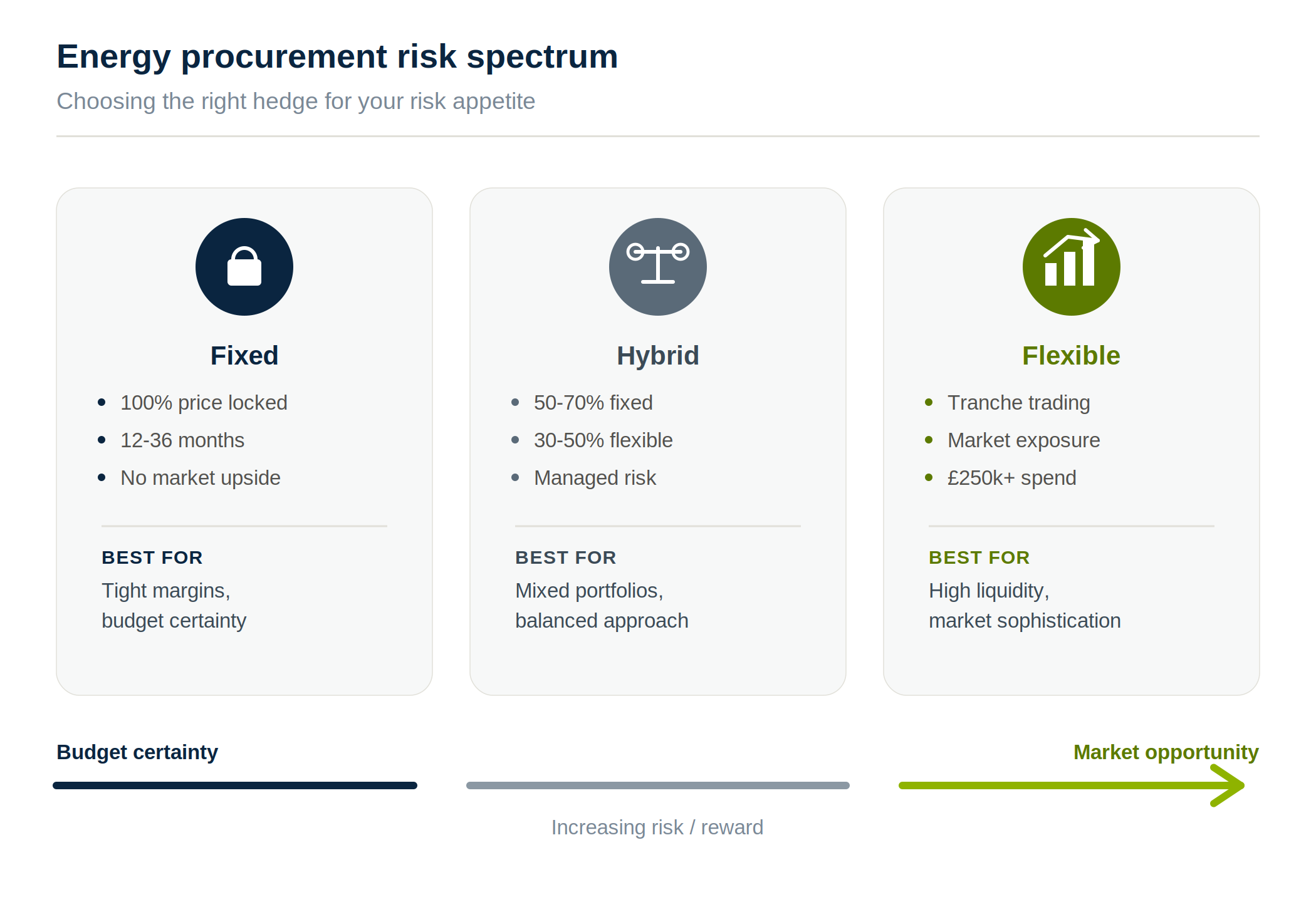
This is a “buy-and-hold” strategy where the price is locked for 12 to 36 months.
- Strategic Role: Provides 100% budget certainty. It is the preferred choice for organisations with fixed margins that cannot absorb mid-year price fluctuations.
- Market Trend: Ofgem’s latest data indicates a resurgence in fixed-term contracts as businesses seek refuge from extreme volatility. However, “fixed” often only applies to the commodity; non-commodity costs may still be “pass-through,” meaning the bill can still fluctuate.
2. Flexible Energy Procurement
Ideal for organisations with an annual spend exceeding £250,000, this model allows for purchasing energy in “tranches” throughout the contract term.
- Strategic Role: Enables a business to “average down” its costs by buying more volume during market lows.
- Technical Requirement: This requires expert Energy Portfolio Management provided by Equity Energies. Success is dependent on “Tranche Trading” – the ability to buy Month, Quarter, or Season ahead strips of energy. Without professional trading desks and “stop-loss” triggers, a flexible contract leaves an organisation exposed to peak volatility.
3. Basket and Portfolio Models
For multi-site organisations, energy portfolio planning involves grouping sites into a “basket.” This aggregates volume to access “Tier 1” pricing and spreads the risk across a diverse portfolio of meters. This aggregation allows smaller sites in the portfolio to benefit from the flexible trading power typically reserved for industrial-scale meters.
Aligning Energy with Broader Commercial Goals
In high-performing organisations, energy is no longer managed in a silo. It must integrate with Finance, Operations, and Sustainability.
Financial Governance and Reporting
Energy costs are a major component of the business case for energy efficiency. Professional procurement provides the Energy Price Forecast data required for accurate three-year financial planning, transforming a volatile liability into a predictable operating expense. In 2026, CFOs require “Scenario Analysis” to understand how a 10% or 20% shift in wholesale prices would impact EBIT (Earnings Before Interest and Taxes).
Sustainability and ESG Integration
As organisations respond to the UK’s decarbonisation objectives and increasing stakeholder expectations, renewable electricity procurement can form part of a broader sustainability strategy. Procurement can support renewable electricity reporting through instruments such as Renewable Energy Guarantees of Origin (REGOs). Organisations should ensure that any environmental or carbon-reduction claims are supported by the relevant contractual, certification and emissions-accounting evidence. Organisations are also increasingly considering Corporate Power Purchase Agreements (CPPAs), which can provide long-term price hedging and documented evidence of renewable electricity procurement arrangements.
Operational Intelligence
By using data surfaced through Equity Energies’ proprietary reporting, businesses identify high-usage sites. This allows for a targeted reduction strategy. If one manufacturing facility has a significantly higher “base load” than others, it indicates an operational inefficiency that procurement data has helped to spotlight. This “Energy-Intelligence” loop ensures that procurement isn’t just buying cheaper energy, but helping the business buy less energy.
7 Costly Energy Procurement Mistakes to Avoid at Renewal Time7 Costly Energy Procurement Mistakes to Avoid at Renewal Time
Avoiding common energy buying mistakes is essential for protecting margins. For an expanded breakdown of procurement pitfalls, you can read our dedicated checklist: 7 Costly Energy Procurement Mistakes Businesses Make at Renewal Time.
- Passive Renewal Management: Waiting until the Energy Contract Renewal window is nearly closed. This forces a reactive purchase during a potentially high-market period.
- Ignoring Non-Commodity Inflation: Verified data for 2026 shows that TNUoS (Transmission Network Use of System) charges are set to increase significantly in several regions as the grid is reinforced for net zero. Regional variations mean a business in the South West may face vastly different network cost profiles than one in Scotland, making geographic portfolio analysis essential.
- Inaccurate Volume Forecasting: Most contracts include a “Volume Tolerance” clause (typically +/- 20%). If actual usage deviates beyond this due to site closures or production shifts, suppliers apply heavy penalties based on “take-or-pay” logic.
- Poor Market Timing: Buying into a geopolitical spike. A professional Equity Energies Portfolio Review uses market technicals (Support and Resistance levels) to identify “bearish” trends for purchasing.
- Underestimating Pass-Through Risk: Such as the Nuclear Regulated Asset Base (RAB) levy, which adds an interim rate of approximately £3.49/MWh to support the development of Sizewell C. These costs are often omitted from initial “commodity-only” quotes but appear as significant additions on final monthly invoices. which adds an interim rate of approximately £3.49/MWh to support the development of Sizewell C. These costs are often omitted from initial “commodity-only” quotes but appear as significant additions on final monthly invoices.
- Siloed Decision Making: Procurement that s not aligned with the Sustainability lead can undermine an organisation’s stated carbon-reduction targets or transition plan and may create governance, reporting or tender-related risks where such commitments apply.
- Broker Transparency Issues: Working with consultants who do not provide a transparent breakdown of their commission. Full clarity on FCA-accredited governance is now a requirement for enterprise partners to comply with internal audit standards.
Equity Energies expert perspective: What procurement teams should prioritise now
To provide true expert insight, it is necessary to look at the technical shifts occurring in the UK grid.
The Infrastructure Levy Impact:
The UK is entering a period of massive grid investment. Parliamentary briefings confirm that electricity network costs will remain high to fund 2030 Clean Power targets. Procurement teams must move toward a “Demand Side Response” (DSR) mindset, shifting processes away from peak “Red Band” periods (typically 4 PM to 7 PM) to avoid the highest network tariffs. This might involve onsite battery storage or automated load shedding during peak frequency response events.
The Volatility Value Gap:
Verified 2026 data shows that wholesale prices can fluctuate by over 25% in a single week based on LNG arrival schedules and wind output. Success now requires Energy Portfolio Management that treats energy as a live commodity, using Energy Data Reporting to make real-time adjustments to hedging positions. Businesses that fail to monitor the market daily are essentially gambling with their operational margins.
Frequently Asked Questions
How does the process work for multi-site businesses?
By aligning the renewal dates of all sites to a single “Common End Date,” organisations create a massive volume block. This provides significantly more leverage during Business Energy Tendering, allowing access to the larger wholesale trading desks of suppliers and reducing the administrative burden of managing multiple rolling contracts.
Why are non-commodity costs rising so fast?
These costs fund the UK’s transition to a low-carbon grid. They include the Capacity Market payments that ensure grid stability when renewable generation is low. Equity Energies helps organisations manage these costs by optimising agreed capacity (kVA) and reducing peak-time usage.
What is the “British Industrial Competitiveness Scheme”?
The Government announced the BICS to provide electricity bill relief for manufacturers by providing exemptions from the indirect costs of the Renewables Obligation and Feed-In Tariffs. Understanding eligibility is now a critical part of the procurement process for energy-intensive industries such as chemicals, steel, and paper, where these exemptions can reduce total energy spend by up to 15%.
Ready to Refine Your Energy Procurement Strategy?
The difference between a standard renewal and a data-driven Energy Buying Strategy is the difference between profit and loss. At Equity Energies, the focus is on providing the technical depth and market intelligence required to transform your energy spend into a managed asset.
Effective energy management requires a combination of market timing, data integrity, and engineering expertise. Whether you need a comprehensive energy portfolio review to identify hidden network costs or a second opinion on an upcoming energy contract renewal, our experts provide the necessary clarity to navigate a high-cost market.