The grid has given us an important lesson about sequencing, not solar.
A community solar project in the Southwest is spending its first summer switched off, not because of a fault or a lack of sunshine, but because the local grid cannot safely accommodate the electricity it was built to generate. It’s a timely reminder that investing in new energy infrastructure is only part of the picture. Grid capacity and network infrastructure need to keep pace too, especially for organisations planning their own energy investments.
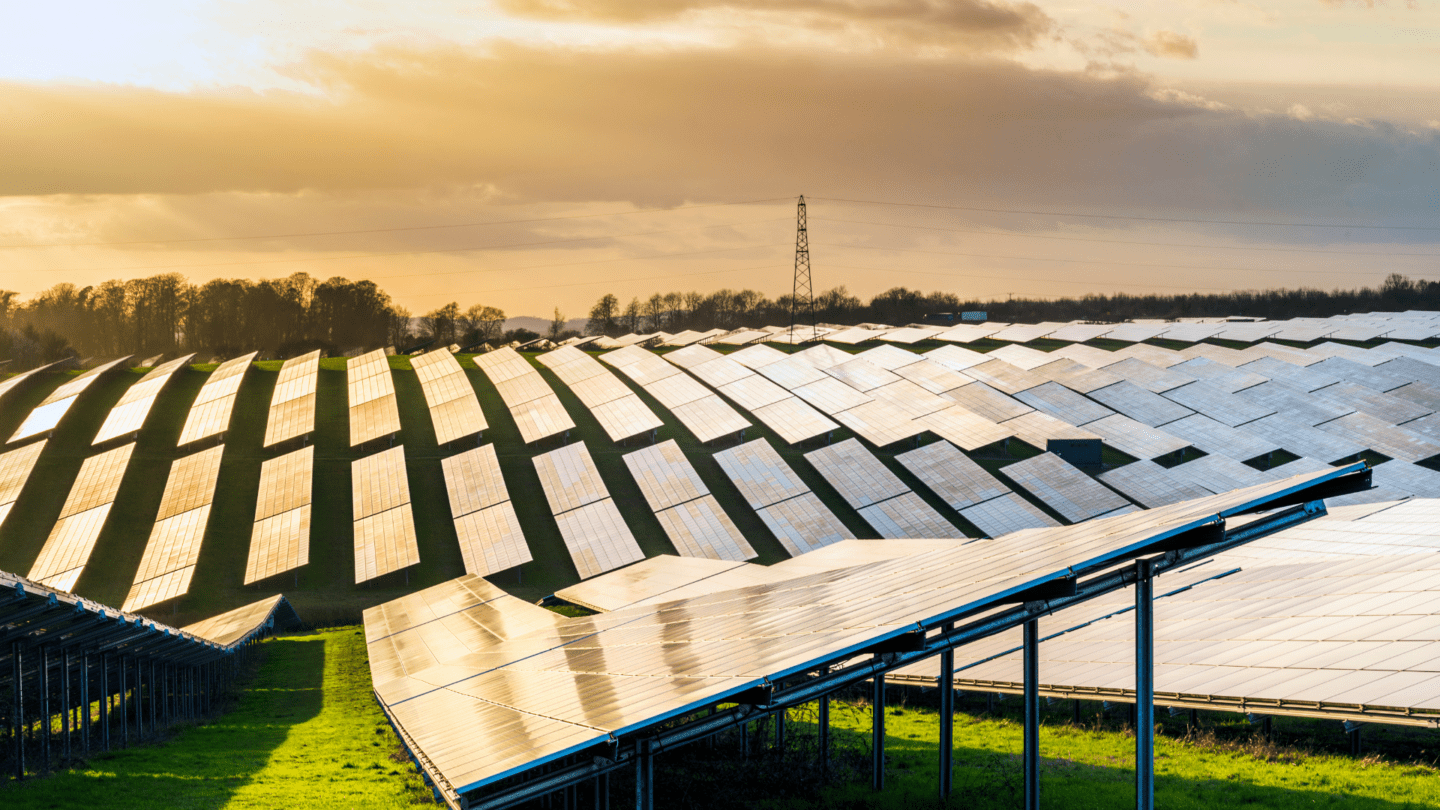
A community solar project in the Southwest is spending its first summer switched off, not because of a fault or a lack of sunshine, but because the local network is not able to safely absorb the electricity it should be generating.
This is a story that deserves more attention and careful consideration than it’s had.
The temptation is to treat this as evidence that something is broken in the system, but I don’t think that is the right conclusion. What it does show is a system being rebuilt while it is still running, and what happens when the parts of that rebuild fall out of step with one another.
There is a lesson here for policymakers and network operators, but also a more immediately useful one for organisations planning their own energy investments.
Why has this solar farm been shut down?
In this location in Devon, a large volume of distributed solar had been connected across the area. During long, sunny summer days (of which we’re having many), that generation has been pushing network voltage towards its safe operating limits. The equipment needed to manage this had been identified some time ago but has not yet been installed. Therefore, to keep the network within its limits, generation in the area was curtailed.
No single party has got this wrong. The project was built, financed and connected legitimately, and the network operator acted to keep the system stable, which is precisely its job. Curtailment is not a failure; it’s a normal, if blunt, tool for managing a constrained network, and it’s used more often than most people outside the sector realise.
I believe the problem here is about pace. Generation, even at this scale, can be built in months. But network reinforcement takes years, because it involves a more complex journey of consenting, procurement, supply chains and outage windows that can’t be easily compressed. When the first moves faster than the second, the gap between them must be absorbed somewhere. In this case it was absorbed by a co-operative of ordinary members who had backed the project in good faith and lost a summer of revenue as a result.
That’s a key point to keep in mind; the cost of a sequencing failure does not land on the system; it lands on somebody’s balance sheet.
How does this mirror the balancing act of the energy trilemma?
We talk a great deal about the energy trilemma: the need to balance affordability, security and sustainability at the same time. It has tended to be discussed as an abstraction, but here it is in a single, concrete example.
The sustainability objective was met as more renewable generation was connected. The security objective then asserted itself, because that same generation began to threaten the stability of the network it was connected to. And when those two collided, affordability took the hit, in this case in the form of lost revenue for the people who had funded the asset.
Optimise one part of the trilemma in isolation and the other two will eventually present themselves. That is true at national scale, just as it’s true at the scale of a single site.
What does this mean at organisational level?
Most organisations reading this are not building community solar farms. But the underlying dynamic is one you are exposed to every time you invest in generation, storage, electrification or additional capacity.
I would suggest there are three things that are important to consider.
- Understand what your business case actually depends on
There’s an important distinction between a business case built on exporting power and one built on reducing or avoiding imports. Export revenue depends on a network you do not own, cannot control and have limited visibility of. Avoided import doesn’t. Every unit you generate and consume behind your own meter is a unit you have not bought, and a unit that carries none of the non-commodity charges attached to imported power.
That’s why, for most commercial and industrial sites, the strongest case for solar is now a self-consumption case rather than an export one. This will be less exposed to the constraints of the wider system and aligned with the part of the bill that is rising fastest.
- Read the connection agreement as carefully as the returns model
Curtailment provisions, export limitations, notice periods and compensation arrangements are the terms on which an asset is permitted to earn. In this case, curtailment arrived with little warning and, as we understand it, no compensation. These conditions are all knowable in advance, so financial modelling can and should test out every eventuality before investment is committed.
- Design generation and demand together, not in sequence
This is where battery storage matters, and it is worth being precise about why. Storage would not have solved the problem faced by that solar project, because a battery shifts generation by hours, not by months, and the constraint here lasts an entire season. Storage is not a way to force power onto a network that cannot take it.
Where storage does earn its place is behind the meter, where generation and demand sit on the same site. Here, it gives you control over timing: storing what you generate when you cannot immediately use it and deploying it when import would otherwise be most expensive. Generation gives you volume, and storage gives you control of when that volume is used. It’s the combination of the two, working in unison, that creates commercial value, and it’s worth being clear that the environmental benefit depends on that combination too. Storage on its own increases total consumption, because charging and discharging carry losses.
Why does integration need to be about action?
The phrase “integrated energy strategy” seems to be used so often it risks losing its meaning. This example helps to clarify what it should mean.
Integration means that generation is planned in the context of the network it connects to, and the demand it is meant to serve. It means that procurement, contract structure, capacity agreements and asset investment are treated as one set of interlocking decisions rather than four separate ones. And it means asking, before committing capital, what must be true elsewhere in the system for this investment to deliver what the model says it will.
Those questions might feel somewhat unglamorous, but they are the difference between an asset that performs and an asset that sits idle through the summer, when it should be paying for itself.
What’s the true takeaway?
It would be easy for someone to see this story as a reason for caution around renewables, but that is exactly the wrong lesson. The direction of travel in how we generate and manage energy is not in question, and we believe that on-site generation and storage can be important steps for organisations to take as part of their overarching energy strategies.
The lesson here is about how you move, not whether you move. Plan the connection as carefully as the technology; test the business case against the constraints of the system it sits inside; and consider affordability, security and sustainability together, because they will be considered together whether you choose to or not.
At Equity Energies we work with organisations on the strategy, data and contractual side of that picture, and with Centreco on the design and delivery of on-site solar and storage. The reason we bring those together is precisely because the decisions are not separable, and neither, in our experience, are the consequences of getting them wrong.
Projected savings, payback periods and operational benefits will vary depending on site demand profile, tariff structure, system design and future market conditions.

By Maureen Bray, Managing Director – Equity Energies and Centreco
-

Market Insights
Cutting energy prices won’t fix the UK’s manufacturing’s cost crisis.
Energy UK and the CBI warn that persistently high energy costs are undermining UK manufacturing competitiveness. But the issue goes beyond price alone. Structural charges,…
Find out more -

Business update
Meet Josh Tomlinson: bringing together both sides of the energy market
Equity Energies has appointed Josh Tomlinson as Operations Director. Josh joins from a career spanning wholesale energy trading and customer-side energy procurement and arrives at…
Find out more -
Market Insights
From reporting to reality: what the next wave of corporate sustainability actually looks like
Many organisations have spent the past decade setting sustainability targets, but too often delivery has lagged behind ambition. That is changing fast. Today, expectations are…
Find out more