When the power goes off: energy resilience in food and drink manufacturing
We spend a lot of time talking about the cost of energy. But for food manufacturers, what happens when the energy isn’t there at all? With refrigeration, processing and production often running around the clock, even a short power interruption can have serious consequences for product, compliance and customer orders. As pressure on the UK’s energy system continues to grow, how can food manufacturers protect their operations while also managing costs?
Food price inflation is back in the headlines. The FDF is now forecasting at least 9% food inflation by the end of 2026, driven by rising energy costs, supply chain disruption and input prices that have not fully come down from the spikes of recent years. The recent extreme temperatures and impact on agriculture and raw materials will also not have helped. Manufacturers saw production costs rise 4.4 per cent on average in 2025, and the pressures in 2026 have been intensifying.
Against that backdrop, most of the conversation focuses on the cost of energy. What gets far less attention is what happens when the energy isn’t there at all. For food manufacturers, a power interruption goes beyond being an inconvenience. It can mean product condemned, production halted, compliance called into question, and customer orders missed.
What makes food manufacturing so vulnerable?
Food manufacturing operates under some of the strictest business continuity requirements of any sector. Refrigeration and cold chain integrity are vital. Under UK food safety regulations, if temperatures drift outside safe limits, even briefly, entire batches can be required to be destroyed.
Research from Food Manufacture (July 2026) found that product contamination and recall risk was identified as a leading internal risk by 38 per cent of food manufacturers, up from 31 per cent in 2024. Food safety and health concerns rose from 29 per cent to 45 per cent in the same period.
Energy dependency in the sector tends to be continuous too. Refrigeration, freezing, pasteurisation, cooking and chilling can run around the clock and unlike many other sectors, there’s very limited scope to shift load, reduce consumption, or ride out even a brief outage. A food factory’s energy profile is close to non-negotiable.
What does a power interruption cost?
The direct cost of an outage depends on what you produce, how much stock is at risk, and how long the interruption lasts. But the costs can compound very quickly. Condemned product is a write-off, production downtime means orders are missed or delayed, and a food safety investigation can have a longer lasting effect and pause operations further. If you supply into a major retailer’s supply chain, a disruption to your output can trigger penalties and contract reviews that outlast the initial event.
IDS-INDATA research estimates that UK and European manufacturers are projected to lose between £124 billion and £157 billion to unplanned downtime across all sectors in 2026. Food manufacturing, with its perishable product, strict compliance requirements and continuous operating profile, risks making up a large part of that figure.
There’s also hidden cost beyond the immediate impacts, often in the process of recovery: diagnosing what happened, restarting safely, proving that the cold chain was not broken, and rebuilding confidence with customers who rely on your ability to deliver consistently. For businesses operating on margins already under severe pressure, even a short outage can have serious and long-lasting consequences.
Why is the risk increasing?
The UK’s electricity grid is under growing strain due to demand increasing, ageing infrastructure, and connection upgrades that are slow and expensive. The queue for new grid connections is substantial, and timelines of several years are common even for sites that are ready to invest.
Climate-related weather events are further compounding the problem. Heatwaves increase cooling demand at exactly the same time that grid stress is at its highest, so a site that can manage a brief interruption on a cool spring day may not tolerate the same event during a heatwave, when ambient temperatures are higher and refrigeration has to work harder.
The UK also has the second-highest industrial electricity prices of any IEA member country, at around 40 per cent more than the Netherlands and 35 per cent more than Spain (source: Full Fact, October 2025). When you’re already paying a premium for every unit of power, the consequences of that power failing can easily become magnified.
What can food manufacturers do?
The practical options for managing resilience are more accessible than many manufacturers realise, and importantly, most of them also have the potential to reduce cost.
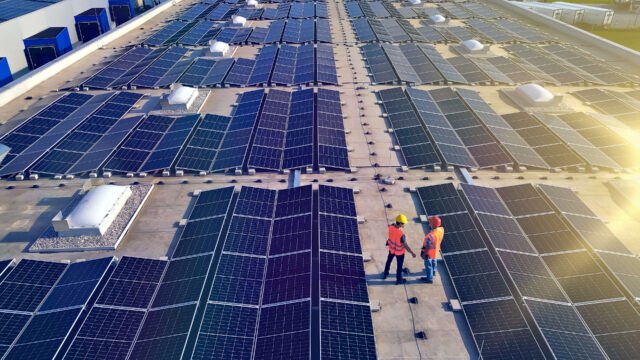
On-site solar generation reduces dependence on grid imports, which means less exposure to both supply interruption and rising non-commodity charges. For sites with suitable roof space and structural capacity, solar is now a proven and commercially established option. Where rooftop installation is not practical, ground-mounted arrays or a sleeved power purchase agreement, where power is generated off-site and contracted directly to you, can achieve a similar outcome.
Battery storage adds a layer of flexibility that goes beyond cost management. It can provide short-duration backup during grid instability, shift consumption away from peak-cost periods, and in combination with solar, allow a site to generate, store and deploy its own power when it is most needed. For a food manufacturing site running continuous refrigeration, timing control can be the solution to riding out a grid event.
Backup generation provides the most direct form of resilience: the ability to keep critical processes running regardless of what is happening on the grid. For sites where any interruption to refrigeration, freezing or processing would result in product loss or compliance failure, standby generation can provide protection against that cascade of negative outcomes.
Is resilience a separate investment from cost management?
This is the question I get asked most often. The answer is that resilience and cost management are much closer together than many people expect, when you consider that solar, storage and backup generation all serve both objectives. A resilience-first strategy and a cost-first strategy lead to many of the same actions, but the difference is in how you frame the business case.
There’s a third outcome that ties both together even more closely. The same measures that reduce cost and strengthen resilience can also improve your carbon position. On-site generation lowers Scope 2 emissions, and reduced grid dependency means less exposure to the carbon intensity of imported electricity. And where a supply is backed by Renewable Energy Guarantees of Origin or a power purchase agreement, that reduces reported Scope 2 emissions on the market-based method used under the GHG Protocol; it does not change the physical carbon intensity of the electricity delivered to your site, and the location-based figure required under SECR is unaffected, so both should be reported.
For food manufacturers supplying into major retail chains, that carbon position is becoming a commercial issue in its own right. Cost, resilience and sustainability – referred to as the energy trilemma – are not three separate conversations, but three sides of the same energy strategy.
In the final article, I’ll look at the growing pressure from retailers and brand owners around Scope 3 reporting, and why your energy strategy is about to become your customer’s concern.

Akinola Oladimeji – Business Development Manager, Equity Energies
Projected savings, payback periods and operational benefits will vary depending on site demand profile, tariff structure, system design and future market conditions.
-

Net Zero Pathway
Beyond unit price volatility: The business cost of energy market transformation
The cost of energy used to be a line item on the balance sheet, but they are now intertwined with one of the biggest industrial…
Find out more -
Market Insights
Three pressures, one strategy: understanding the energy trilemma – What the energy trilemma really means for UK organisations
For years, the energy trilemma was a policy issue – governments balancing security, affordability and decarbonisation. Now it’s a business reality. Organisations are feeling it…
Find out more -

Market Insights
Business Energy Consumption Explained: What Drives Usage and What to Do About It
From outdated hardware to operational habits, businesses often leak energy without realising it. Learn how to pinpoint your highest waste areas and implement smarter consumption…
Find out more