Business Energy Consumption Trends: Structural Drivers Shaping Enterprise Demand

Trying to accurately predict corporate energy demand often feels like aiming at a moving target. Large organisations face an ongoing mix of changing network charges, rapidly expanding data workloads, and evolving carbon reporting requirements. For anyone managing a corporate budget, staying ahead means looking past the daily noise of wholesale market fluctuations and focusing on the deeper structural movements altering demand over the long term.
To anchor these choices in a clear framework, many executives find it useful to step back and ask: What does energy procurement mean for large organisations? Understanding these core principles is vital before attempting to map out volatile future costs.
A reliable business energy consumption forecast can no longer be built on historical baselines. Just because your estate used a certain volume of power in the past does not mean it will do so tomorrow. To build a resilient strategy, you must look closely at how new regulations, grid capacity constraints, and aggressive electrification shifts are permanently rewriting the rules of corporate power use.
Divergent Energy Trajectories Across the Estate
To understand how modern demand is shifting, it helps to look at how different commercial sectors are moving in completely opposite directions. While traditional efficiency measures are lowering demand in some areas, digital expansion is aggressively driving it up in others.
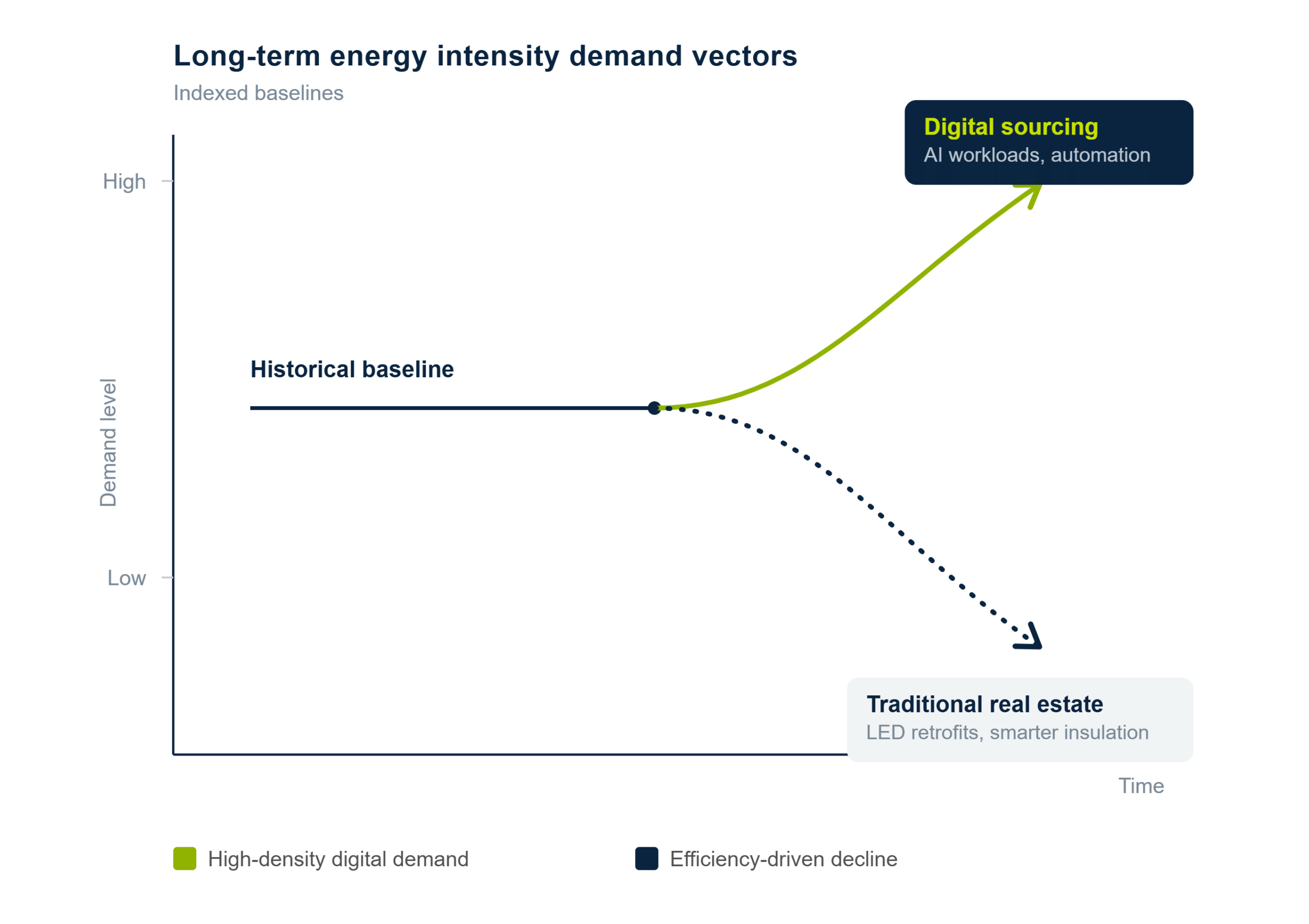
This divergence can make some traditional, portfolio-wide efficiency KPIs (such as aggregate kWh reduced per square meter) less informative for mixed estates. When an estate contains both declining traditional assets and expanding digital infrastructure, looking at a combined historical average masks catastrophic budgetary risks.
- Traditional Real Estate: Decoupling Growth from Consumption
For standard office spaces, retail outlets, and administrative hubs, demand is no longer tied to business growth. It is dictated by efficiency-driven structural decay:
- The LED and HVAC Echo Effect: Ongoing rollouts of smart building management systems (BMS), localised heat-pump retrofits, and high-efficiency LED arrays have permanently lowered the base load.
- The Hybrid Work Variable: Occupancy-driven load profiles have become highly volatile but structurally suppressed, shifting the peak demand windows away from a predictable 9-to-5 baseline.
Consequently, forecasting for these assets requires an asset-by-asset engineering audit rather than standard linear regression based on previous years’ bills.
- Digital & Automated Infrastructure: High-Density, Uncompromising Base Loads
Conversely, logistics fulfilment centres, automated sorting hubs, and high-density computing or data facilities exhibit a completely different physical profile:
- The Elimination of “Off-Peak”: Unlike an office building that goes into “sleep mode” overnight, automated supply chain facilities run continuous multi-shift operations. This transforms a standard daytime peak profile into a massive, flat, 24/7 base-load requirement.
- The AI and Processing Surge: High-density computing assets and localised edge servers have an exponential power-draw profile. A slight increase in data processing volume triggers a non-linear spike in cooling and compute energy demand.
- The Portfolio Forecasting Blindspot
The operational danger lies in the mathematical blending of these two profiles. If an enterprise slashes office consumption by 15% via efficiency, but its data or automation load grows by 15%, the net portfolio volume looks flat on paper.
However, because when and where that power is drawn has completely changed, the business may face heavily inflated network capacity charges, increased exposure to peak DUoS red bands, and potentially higher exposure to wholesale market volatility. A resilient demand forecast must model these asset classes as two entirely separate financial ecosystems.
Grid Constraints and the Reality of Electrification
The biggest driver changing the face of commercial demand forecasting is the steady push to electrify core business operations. Companies are replacing traditional gas boilers with commercial heat pumps and swapping out logistics fleets for electric vehicles.
This shift creates a practical hurdle that many businesses do not see coming until it impacts their expansion plans: local grid distribution capacity.
The core challenge isn’t a shortage of power at a national level. It is the fact that local regional networks are physically constrained. If you expand a facility or install a major EV charging array, you might find that your local network operator simply cannot grant you the extra power capacity (kVA) you need to run them.
The queue for demand connections to the transmission network has grown exponentially, forcing the government and regulator (Ofgem) to overhaul rules to block speculative applications and prioritise “ready and needed” projects. Following the introduction of the Planning and Infrastructure Act, authorities are actively curating the demand queue to favour projects of strategic national importance. In fact, many developers face significant delays not just from administration, but because the physical buildout of high-voltage transmission lines and engineering work is lagging behind the sheer volume of electrification requests.
Because of this, future energy consumption modeling is showing a distinct trend towards onsite generation, commercial Battery Energy Storage Systems (BESS), and intelligent peak-shaving software. Managing this requires a deep look at your current estate infrastructure, which you can explore through our dedicated kVA analysis and grid capacity optimisation services. To see how these physical grid limits should influence your market buying choices, take a look at our comprehensive approach to energy portfolio management and risk mitigation. By actively managing peak demand profiles, businesses may be able to reduce exposure to some network costs and reduce the risk of charges or contractual consequences associated with exceeding agreed grid capacity.
The Growing Power Demand of Digital Workloads
Another permanent shift transforming commercial utility profiles is the sheer speed at which digital workloads are growing. The widespread adoption of cloud computing, machine learning, and artificial intelligence tools means that modern data infrastructure and corporate technology hubs are drawing more power than ever before.
Corporate Electrification: Shifting Load Centres Corporate Electrification: Shifting Load Centres
Traditional Infrastructure Model
├── Gas-Fired Thermal Systems ──► (Direct Fossil Fuel Exposure)
└── Baseline Grid Sourcing ──────► (Standard Commercial Consumption)
Modern Electrified Infrastructure Model
├── Industrial Heat Pumps ───────► (Accelerated Electricity Baseload)
├── High-Density Computing Hubs ──► (Continuous Data Processing Load)
└── EV Fleet Charging Arrays ────► (Volatile Peak Surcharges)
This trend is completely overturning traditional business energy forecasting. In the past, real estate strategies assumed that standard efficiency upgrades—like switching to low-energy LED lighting or improving building insulation—would steadily drag down a company’s total power usage.
Today, the continuous high-intensity power required to run digital infrastructure often wipes out those facility gains entirely. This shift has prompted official UK inquiries into the environmental and utility footprint of data storage systems, with policy focus tightening around how these compute facilities can integrate with local communities via heat network zoning or on-site renewable generation.
Corporate procurement teams can no longer afford to look at IT requirements and real estate footprints as two separate worlds. They have to combine these data sets to form an accurate energy consumption forecast. To keep track of how these macroeconomic pressures play out across the wider UK infrastructure, your team can monitor our regular Knowledge and Insights platform.
“Looking at aggregate, portfolio-wide energy data creates a dangerous mathematical illusion. While net volume may look flat on paper, shifting asset profiles quietly expose businesses to massive fixed network charges.”
The Operational Imperative of Demand-Side Flexibility
As baseload requirements climb, forward-thinking enterprises are moving away from passive energy consumption and toward operational flexibility. The UK energy landscape is increasingly structured to reward organisations that can dynamically shift their power use away from moments of peak grid stress.
This is being achieved through the expansion of frameworks like the National Energy System Operator (NESO) Demand Flexibility Service. This service has evolved beyond a winter-only contingency option into an enduring, year-round merit-based margin tool. Furthermore, recent overhauls allow bi-directional flexibility, meaning that industrial and data assets are now financially rewarded for turning up their demand to absorb excess green electricity on the grid, as well as turning it down during peak stress.
By deploying behind-the-meter battery storage (BESS) or using microgeneration assets like solar arrays, a business can effectively isolate itself from grid volatility. Where tariff structures and site controls allow, properties can discharge stored energy during higher-cost periods and recharge at lower-cost times. Integrating this type of structural elasticity directly into your long-term forecasting models changes energy from a rigid, uncontrollable overhead into an active, strategic tool that can generate ancillary revenue streams while insulating your operating margins.
The Rise of Off-Site Structuring: Corporate PPAs
As localised grid capacity constraints limit on-site generation potential, a major trend reshaping enterprise procurement is the surge in Corporate Power Purchase Agreements (CPPAs). With non-commodity costs projected to sit at roughly 60% of average business electricity invoices, traditional short-term utility contracts leave organisations exposed to severe delivery tariff hikes. To insulate themselves, large enterprises are entering into long-term financial or physical agreements directly with renewable energy developers, often stretching over 10 to 15 years. By anchoring a portion of their baseline demand to a dedicated off-site wind or solar asset, corporate buyers secure long-term price certainty, lock down verified additionality for their carbon accounting, and bypass localised grid capacity limits.
Shifting Regulatory Pressures and Scope 3 Rules
Changes in government regulations will continue to dictate energy demand trends. The big operational shift is that carbon reporting has moved away from voluntary, good-will disclosures and turned into strict statutory mandates backed by heavy financial penalties.
Timeline of Regulatory Impacts on Corporate Utility Planning
| Baseline Phase | Operational Phase | Compliance Phase |
| Auditing historical gaps and compliance exposures | Implementing half-hourly automated tracking | Mandatory supply-chain scope-3 carbon reporting |
With mandatory compliance audits now covering Scope 3 supply chain emissions, companies are being forced to take complete control of their utility data. Driven by frameworks like the UK’s Sustainability Disclosure Requirements (SDR), large enterprise buyers are now filtering their suppliers based entirely on carbon intensity metrics. You cannot manage what you do not measure, and you certainly cannot report it to an auditor.
This push coincides directly with the Market-wide Half-Hourly Settlement (MHHS) rollout. This regulatory programme mandates that all non-domestic electricity meters transition to granular, half-hourly data settlement, completely replacing old-fashioned, manual spreadsheet tracking with continuous automated data loops.
The Impact of the Targeted Charging Review (TCR)
While keeping an eye on how much energy you use is critical, you also have to anticipate changes in how you are billed for that energy. Wholesale power rates are only one part of the story; non-commodity delivery charges and grid maintenance levies are eating up a bigger percentage of the average commercial invoice every single month.
Under the Targeted Charging Review (TCR) frameworks, the way these network charges are calculated has completely transformed. It marks a fundamental shift from volatile, usage-based peak consumption charges (such as the historical winter Triad framework) to fixed daily residual bands based on your meter type and agreed capacity.
This means that traditional methods of avoiding network charges simply by reducing peak load during specific intervals no longer yield the same cost reductions for Transmission Network Use of System (TNUoS) fees. With TNUoS residual tariffs seeing dramatic increases—often surging by over 60%, moving from approximately £16/MWh closer to £31/MWh for standard half-hourly assets—large commercial and industrial properties face substantial baseline budget adjustments regardless of how efficiently they run day-to-day. If your business has an incorrect capacity declaration on its contract, you could be paying massive, compounding fixed penalties without even realising it. To verify that your parameters are accurate and protect your bottom line, read our guide on the 7 costly energy procurement mistakes businesses make at renewal time.
Mapping out this exposure requires expert planning, which is why utilising advanced budget forecasting and energy market intelligence services is so important for protecting your operating cash flow. When you are preparing for upcoming contract renewals, making sure you don’t get caught out by these structural changes is vital—take a look at our core Energy Procurement solution brief to make sure your purchasing strategy is sound.
Wholesale commodity energy is only one part of your financial exposure. Non-commodity charges can represent a substantial proportion of a business electricity invoice, but the proportion varies by customer, tariff, charging year and consumption profile:
- Fixed Elements (TCR Impact): TNUoS transmission fees have shifted to fixed daily bands, and BSUoS (balancing costs) have similarly transitioned into a fixed-rate structure for demand customers, significantly raising your baseline budget regardless of day-to-day efficiency upgrades.
- Time-Variable Elements: Regional distribution tariffs (DUoS) still utilise strict red, amber, and green time-of-use bands. Additionally, Capacity Market charges contribute to electricity costs and should be considered alongside other network and policy charges; they should not be described as a direct penalty on individual peak consumption without reference to the applicable charging mechanism.
Because of this dual structure, a modern energy strategy must be two-pronged: optimising your fixed parameters (such as reviewing your Authorised Supply Capacity to avoid compounding penalties) while simultaneously mapping out time-of-use profiles to shift flexible workloads away from punitive DUoS red bands.
Frequently Asked Questions
Why is local network capacity a risk for future energy consumption planning?
As commercial estates electrify their transport fleets and heating systems, local electricity grids face severe capacity issues. This means expanding facilities or distribution centres may struggle to secure increased power allocations (kVA) without deploying onsite generation or battery storage. The Government’s “First Ready, First Connected” reforms aim to clean up connection queues, but infrastructure bottlenecks remain an active commercial barrier.
How do digital workloads affect standard business energy forecasting models?
Modern high-density digital processing, cloud workloads, and AI infrastructure require significant, continuous power. These digital loads can counteract standard real estate efficiency gains, like LED retrofits, meaning IT infrastructure expansion must be actively modelled within your utility projections.
What role do non-commodity delivery fees play in demand forecasting?
Non-commodity elements, including network maintenance, transmission costs (TNUoS), and system balancing fees, make up over half of a modern electricity invoice. Accurate demand forecasting must track exactly when an organisation uses power, as running heavy processes during peak regional grid windows incurs severe financial tariff surcharges on the remaining variable elements
Navigating the Next Era of Demand
Navigating these changing market signals requires moving away from traditional, reactive purchasing habits and embracing a unified, forward-looking energy strategy. Companies can no longer afford to treat utility procurement and operational efficiency as separate corporate silos.
To build true operational resilience, an enterprise must combine its long-term market forecasts with localised efficiency plans. This means matching wholesale risk management strategies directly with real-time site consumption updates and proactive asset upgrades. By building a unified data foundation, large organisations gain the operational clarity needed to spot cost risks early, capitalise on flexible market opportunities, and turn shifting market trends into a distinct competitive advantage.
To keep pace with changing market dynamics and explore further industrial insights, visit our Knowledge and Insights library.
Have a specific question about your estate’s energy strategy? Contact the Equity Energies team today.
-

Energy Procurement
Business Energy Consumption Trends: Structural Drivers Shaping Enterprise Demand
Trying to accurately predict corporate energy demand often feels like aiming at a moving target. Large organisations face an ongoing mix of changing network charges,…
Find out more -

Market Insights
What Good Energy Reporting Should Tell a Finance or Estates Team
If you are managing a large, multi-site business, you already know that energy has long moved past being a simple utility bill. It can now…
Find out more -

Energy Procurement
Business Guide to Energy Procurement
What does energy procurement mean for large organisations? For the modern enterprise, energy has shifted from a passive operational cost into a primary strategic risk.…
Find out more